Fingers, Ears, Brain
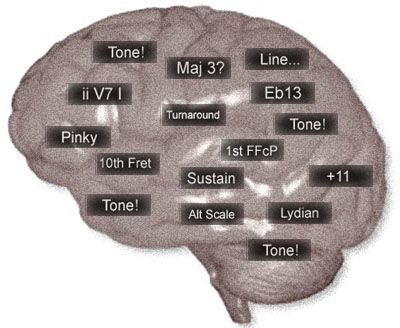
The human brain is as unique from person to person as snowflake to snowflake. We all have individualized approaches to the way we learn and process information. Development in playing ability requires a sensitivity to these differences, but we want to offer our perspective and strategy on how to best develop as a player within a tolerance for other pedagogical tactics. Ours is stated simply "Fingers, Ears, Brain."
While teaching undergraduate theory, I couldn't help but notice how my freshmen introductory music theory students tackled learning scale and chord principles. I'd see my saxophonists fingering "Air" sax, piano players wriggling their digits, violinists moving up and down an imaginary fingerboard, and very entertaining to watch those wacky trombone players!...
Why? They could process intellectual concepts with a physical or tactile reference much more quickly. They had spent the last five to ten years developing skills on these instruments; returning to the familiar corporeal allowed them this immediate reference. Consider your own mandolinning. Are you the type to create a mental still of a standard notation or TAB, or are you likely to feel the fretboard location in your fingers when tackling new music? Why not use this approach to higher level concepts in music theory?
We use this approach in the upcoming Mel Bay book (Getting Into Jazz Mandolin) and throughout our Downloadable Exercises on the website. It's the essence of the FFcP approach. Fantastic stretching and facility development, but what we hope for is a future intellectual grasp, a mind/body anchor for chord and note relationships.
As you are mastering the exercises, tone, proper posture are your first consideration, but you want to put these on "autopilot" later and start to hear these note and scale relationships. Ear/finger coordination will allow you to invent new material as if you were singing them instead of playing them.
Next, start thinking note names as you are playing. Not necessarily everynote, but at least be aware of the critical, defining notes, the 1st, the 5th, the 3rd, etc. For example, in the Ab pattern, call out the Ab, call out the Eb, notice the tactile and aural relationship (one string over!), figure out where the 3rd and 7th are. Are they Major or Minor? Which are the "pull" or gravity notes? This is the "higher level" part of learning as you finesse the physical.
Basically, learn these drills so well that you can forget them.
You may be a visual person, you may be an aural. Do you learn better by reading words, or hearing them? With the Fingers/Ears/Brain approach, you can still enjoy the benefits of either method. Visual learners, read it on the page, but strive to memorize and get it in your fingers. Aural learners, analyze the patterns and play the fingerings, but still strive for some sort of intellectual awareness of note relationships.
Basically, learn these drills so well that you can forget them. That's where the higher level music theory cerebral ability can run wild!

Disclaimer: In the 'Information Age' of the 21st Century,
any fool with a computer, a modem, and an idea can
become a self-professed 'expert." This site does not
come equipped with 'discernment.'
|